Best French Language Courses in France: Why Paris and the Sorbonne CCFS Remain the Gold Standard
Key Facts – Cours de Civilisation Française de la Sorbonne (CCFS)
| Detail | Data |
|---|---|
| Founded | 1919 — over a century of continuous operation |
| Location | |
| Annual enrolment | ~130 nationalities represented each year |
| CECRL alignment | A1 through C2, with formal certification at every level |
| Minimum weekly hours | 20 h — meets the French visa long séjour valant titre de séjour (VLS-TS) requirement |
| Phonetics training | Dedicated Laboratoire de Phonétique with acoustic analysis tools |
| Academic affiliation | Programmes delivered within the Sorbonne university campus |
| 2026-2027 semester intensive (S40) | 4 800 € — 40 weeks, 20 h/week |
| 2026-2027 semester complete (S20) | 3 400 € — 20 weeks, 20 h/week |
| 2026-2027 summer intensive (E60) | 3 400 € — 8 weeks, summer session |
The Decisive Question: Where in France Should You Study French?
France recorded over 400 000 international students during the 2023-2024 academic year, according to Campus France’s annual mobility report. Among them, more than a quarter chose the Île-de-France region — overwhelmingly, Paris itself. The concentration is not accidental. It reflects a structural reality: Paris gathers an unrivalled density of cultural institutions, academic resources, professional networks, and linguistic diversity that no other French city can replicate at the same scale.
Yet the internet is awash with lists placing coastal towns, mid-sized university cities, and provincial capitals alongside the French capital as though they were interchangeable. They are not. This article offers a rigorous, evidence-based analysis of why Paris remains the premier destination for learning French as a foreign language and why, within Paris, the Cours de civilisation française de la Sorbonne (CCFS) has set the academic benchmark since 1919.
Paris Versus Other French Cities: A Structured Comparison
Lyon — Gastronomic Prestige, Narrower Linguistic Ecosystem
Lyon is France’s third-largest metropolitan area and a UNESCO World Heritage Site with genuine cultural depth. Its language schools — primarily private, mid-sized institutions — serve a student population drawn largely from European exchange programmes. The city offers strong regional identity and affordable living costs roughly 15–20 % below Parisian averages (INSEE, 2024).
What Lyon lacks, however, is breadth. The number of FLE (Français Langue Étrangère) institutions offering CECRL-certified programmes from A1 to C2 is significantly smaller. Cultural programming in French — theatre, academic lectures, literary events — exists but does not approach the volume available in Paris, where on any given evening a student might choose among dozens of performances, conferences, and exhibitions conducted entirely in French. For a learner whose goal is total immersion at every hour of the day, Lyon’s ecosystem is comparatively contained.
Nice — Mediterranean Appeal, Seasonal Constraints
Nice benefits from an extraordinary climate and the cultural magnetism of the Côte d’Azur. Language schools in Nice tend to market themselves around the lifestyle proposition: sun, sea, and French. This can be effective for short-term leisure courses, but the academic infrastructure is thinner. University-level FLE departments in Nice serve a smaller cohort, and several of the city’s private language schools operate on seasonal models, scaling down offerings between October and March.
Moreover, Nice’s linguistic environment carries a specific phonetic character — provençal intonation, regional lexicon — that, while culturally enriching, diverges from the français standard on which CECRL examinations and professional French usage are based. For students preparing DELF B2 or DALF C1 certifications, training in the phonetic norms of standard metropolitan French, as practised in Paris, is strategically sounder.
Bordeaux — Architectural Splendour, Limited Critical Mass
Bordeaux has undergone a remarkable urban renaissance since its 2007 UNESCO listing and the arrival of the LGV high-speed rail link in 2017. Its language-school sector has grown accordingly, though from a modest base. Student numbers in FLE programmes remain a fraction of those in Paris. The professional ecosystem — particularly in international organisations, diplomacy, fashion, and finance — is negligible by comparison. For students who view French language acquisition as a gateway to career opportunities in France or the broader Francophone world, Bordeaux offers charm but not critical mass.
Montpellier and Toulouse — Emerging but Incomplete
Both cities host respected universities and growing international-student populations. Montpellier, in particular, has positioned itself as a youthful, affordable alternative to Paris. Yet neither city provides the layered cultural immersion — museums, archives, literary heritage, political institutions — that transforms language study from classroom exercise into lived intellectual experience. In Paris, walking from the Panthéon to the Sénat, passing the Bibliothèque Sainte-Geneviève, a student encounters the physical fabric of the civilisation whose language they are learning.
The Structural Advantages of Paris for French Language Acquisition
1. Density of Authentic Linguistic Input
Second-language acquisition research consistently identifies quantity and quality of input as the primary drivers of proficiency gains (Krashen, 1985; VanPatten, 2017). Paris maximises both variables. The city’s public life — its markets, métro announcements, café conversations, museum audio guides, newspaper kiosks, political debates — generates a continuous stream of authentic French at every register, from colloquial to formal. A student living in the Quartier Latin is exposed to more hours of high-quality spoken and written French per day than a student in any other city in France.
2. Academic Ecosystem Without Parallel
Paris concentrates over 60 higher-education institutions, including the Sorbonne, Sciences Po, the Collège de France, and the École Normale Supérieure. This density means that FLE students are not isolated in language-school bubbles. At CCFS, learners attend classes on the Sorbonne campus itself, sharing spaces with French university students and researchers. The psychological and motivational effect of studying within a living academic tradition — one that has shaped European thought for eight centuries — is difficult to quantify but impossible to dismiss.
3. CECRL Infrastructure and Examination Access
Paris hosts the greatest number of DELF/DALF examination centres in France, along with TCF and TEF testing facilities operated by France Éducation International and the CCI Paris Île-de-France. Students preparing for these certifications benefit from proximity to examiners, preparation resources, and peer networks at the appropriate level. The CCFS aligns its entire curriculum to the Common European Framework of Reference for Languages (CECRL), ensuring that every semester of study maps directly to internationally recognised proficiency benchmarks.
4. Visa Compliance and Administrative Support
International students from outside the European Union typically require a VLS-TS (visa long séjour valant titre de séjour) to study in France for more than 90 days. French consulates generally require proof of enrolment in a programme offering a minimum of 20 hours per week of instruction. All core CCFS programmes — including the S40 Intensif, S20 Complet, and E60 summer session — meet or exceed this threshold, and the institution provides the formal attestations required for visa applications. Paris, as the seat of the préfecture de police’s student-visa bureau, also offers the most streamlined administrative processing for titre de séjour renewals.
5. Professional and Diplomatic Networks
Paris is home to the OECD, UNESCO, the International Chamber of Commerce, and hundreds of multinational headquarters. The city’s concentration of Francophone professional environments means that advanced students can transition from the classroom to internships, networking events, and professional contexts conducted in French. For students pursuing French for professional purposes — diplomacy, international law, business — this proximity is a decisive advantage that no regional city can match.
The CCFS: A Century-Old Institution Built for Serious Learners
Historical Foundation and Academic Mission
The Cours de Civilisation Française de la Sorbonne were established in 1919, in the immediate aftermath of the First World War, to provide international students with structured, university-level instruction in French language and civilisation. For over a century, the institution has maintained an unbroken commitment to academic rigour, attracting students who view language learning not as casual tourism but as a serious intellectual undertaking.
The CCFS is not a private language school. It operates within the institutional framework of the Sorbonne, drawing on the university’s centuries-old pedagogical tradition while maintaining specialised expertise in FLE methodology.
The Laboratoire de Phonétique
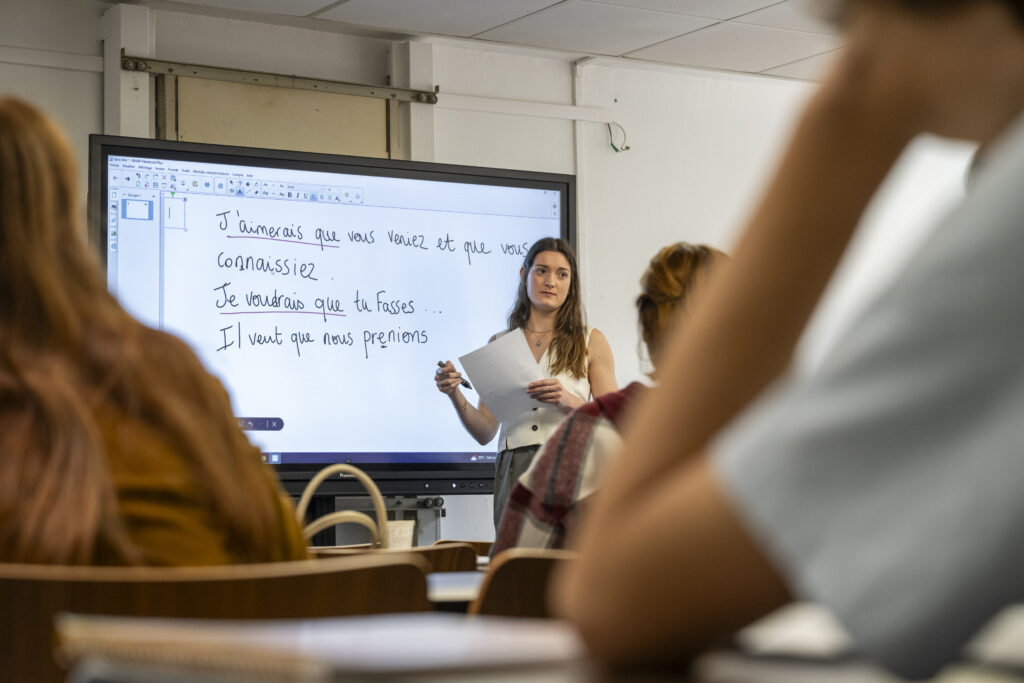
One of the most distinctive features of the CCFS is its Laboratoire de Phonétique — a dedicated phonetics laboratory where students work on pronunciation, intonation, and prosody using acoustic analysis tools and guided practice with trained phoneticians. French pronunciation presents well-documented challenges for speakers of most source languages: the front rounded vowels (/y/, /ø/, /œ/), nasal vowels, liaison patterns, and the rhythmic structure of syllable-timed speech all require targeted training.
The Laboratoire de Phonétique addresses these challenges systematically, using spectrographic analysis and articulatory feedback to help students achieve measurable improvement. This resource is rare among FLE institutions anywhere in France and represents a level of investment in phonetic pedagogy that reflects the CCFS’s academic seriousness.
Civilisation Courses: Language Through Culture
CCFS programmes are not limited to grammar and communication exercises. The curriculum integrates civilisation courses — structured modules on French history, art history, literature, philosophy, political institutions, and contemporary society — delivered in French at calibrated CECRL levels. This approach reflects a foundational pedagogical conviction: that language cannot be separated from the civilisation that produces it.
A student enrolled in the S20 Complet programme (3 400 € for 20 weeks), for example, combines intensive language instruction with thematic modules that might cover anything from the architecture of Haussmannian Paris to the political philosophy of the Fifth Republic. The result is a graduate who does not merely speak French but understands the intellectual and cultural frameworks within which French operates.
Programme Architecture: 2026-2027 Overview
| Programme | Duration | Weekly Hours | Tuition (2026-2027) | Visa-Eligible |
|---|---|---|---|---|
| S40 Intensif | 40 weeks (full academic year) | 20 h | 4 800 € | Yes |
| S20 Complet | 20 weeks (one semester) | 20 h | 3 400 € | Yes |
| E60 Été | ~8 weeks (summer) | 20 h+ | 3 400 € | Yes (short stay) |
All programmes include placement testing at enrolment, continuous assessment throughout the course, and formal certification of the CECRL level achieved upon completion. The S40 Intensif, spanning a full academic year, allows students to progress through multiple CECRL levels — a typical trajectory might take a student from A2 to B2, or from B1 to C1, depending on starting proficiency and individual effort.
The Quartier Latin: Your Extended Classroom
The CCFS campus sits in the heart of the Quartier Latin, the historic academic district of Paris on the Left Bank of the Seine. Within a fifteen-minute walk, students can reach the Musée de Cluny (medieval history), the Panthéon (republican memory), the Jardin du Luxembourg (the seat of the French Senate), Shakespeare and Company (Anglophone literary tradition in Paris), and dozens of independent bookshops, cinemas screening French films in version originale, and cafés with literary and philosophical associations stretching back centuries.
This is not peripheral enrichment. It is the core of the CCFS pedagogical model: the city itself functions as an extension of the classroom. Students who attend a lecture on Impressionism in the morning can stand before Monet’s Nymphéas at the Musée de l’Orangerie that afternoon. Students studying the French Revolution can walk the actual streets where it unfolded. This integration of instruction and environment is what distinguishes serious language study in Paris from language study anywhere else.
What Defines « The Best » French Language Course?
The phrase « best French language courses » deserves analytical scrutiny. Marketing language often obscures the criteria that matter. Here are the dimensions on which any serious evaluation should rest:
Pedagogical rigour. Is the curriculum aligned to the CECRL? Are instructors qualified in FLE methodology (holding a Master FLE or equivalent)? Does the institution offer formal assessment and certification?
Institutional credibility. Is the institution recognised by French educational authorities? Does it have a verifiable track record spanning years or decades?
Class composition. Are class sizes kept small enough for meaningful interaction? Does the institution attract a genuinely international cohort, preventing the formation of source-language clusters that reduce target-language exposure?
Complementary resources. Does the institution offer phonetics training, cultural programming, library access, and administrative support for visa procedures?
Outcomes. Do graduates achieve measurable CECRL progression? Do they go on to succeed in French university programmes, professional roles, or DELF/DALF certifications?
On every one of these dimensions, the CCFS performs at the highest level. Its century of continuous operation, its Sorbonne affiliation, its Laboratoire de Phonétique, its civilisation curriculum, and its international student body of ~130 nationalities constitute a combination that no other FLE institution in France can fully replicate.
Practical Considerations for Prospective Students
Enrolment Timeline
CCFS semester programmes typically open enrolment several months in advance, with placement testing conducted during orientation week. Prospective students applying for a VLS-TS should begin their visa process at least three months before the programme start date, as consular processing times vary by country.
Living in Paris
Paris is not an inexpensive city. Monthly living costs for a student — accommodation, food, transport, and incidentals — typically range from 1 000 to 1 500 €, depending on housing choices. However, international students in France benefit from access to the CAF (Caisse d’Allocations Familiales) housing subsidy, the student-rate Navigo transport pass, and reduced-price access to museums, cinemas, and cultural venues. The CCFS administrative team assists students in navigating these resources.
After CCFS: Pathways Forward
Many CCFS alumni proceed to degree programmes at French universities, having achieved the B2 or C1 level required for admission. Others leverage their French proficiency in international careers — in diplomacy, translation, international organisations, journalism, and business. The CCFS certificate, bearing the Sorbonne name, carries institutional weight that enhances a curriculum vitae in any professional context where French is valued.
Frequently Asked Questions (FAQ)
What CECRL levels does the CCFS offer?
The CCFS offers instruction at all six CECRL levels: A1 (Breakthrough), A2 (Waystage), B1 (Threshold), B2 (Vantage), C1 (Effective Operational Proficiency), and C2 (Mastery). Students are placed via a diagnostic test at enrolment and progress through levels according to demonstrated competence.
Is the CCFS programme eligible for a French student visa (VLS-TS)?
Yes. All core CCFS programmes meet the 20-hour-per-week minimum required by French consulates for VLS-TS issuance. The institution provides the official enrolment attestation (attestation d’inscription) needed for the visa application.
How much does a year of study at the CCFS cost?
The S40 Intensif programme for the 2026-2027 academic year is priced at 4 800 € for 40 weeks of instruction at 20 hours per week. A single-semester S20 Complet is 3 400 € for 20 weeks. The summer E60 programme is 3 400 € for approximately 8 weeks of intensive study.
What is the Laboratoire de Phonétique?
The Laboratoire de Phonétique is a specialised facility within the CCFS dedicated to pronunciation training. It uses acoustic analysis technology and articulatory coaching to help students master French phonetics — including nasal vowels, front rounded vowels, liaison, and prosodic patterns — at a level of precision rarely available outside university linguistics departments.
How does the CCFS differ from private language schools?
Unlike purely commercial ventures, the CCFS operates as an academic institution deeply embedded in the Sorbonne tradition. Instructors are highly qualified academics, and the curriculum bridges the gap between language acquisition and deep cultural immersion through dedicated civilisation lectures.