William of Rubruck: the french explorer who beat Marco Polo to the mongol empire
When we think of medieval European explorers journeying to the Far East, one name invariably comes to mind: Marco Polo. His tales of Xanadu and the court of Kublai Khan have fired the imagination for centuries. But what if we told you that decades before Polo’s famous journey, a Franciscan friar from the Kingdom of France undertook an even more arduous mission to the heart of the formidable Mongol Empire?
His name was William of Rubruck (Guillaume de Rubrouck), and his story is a crucial, though often overlooked, chapter in the history of French civilization and global exploration. For students learning French, his journey reveals a side of France’s past that extends far beyond its European borders, demonstrating a medieval spirit of inquiry and diplomacy. At the Cours de civilisation française de la Sorbonne (CCFS), we believe that understanding these pioneering figures provides a deeper context to the language and culture you are studying.
A mission forged in the heart of Royal and intellectual power
William of Rubruck’s incredible journey was born at the very intersection of royal power and intellectual fervor that defined 13th-century France. A Franciscan friar from Flanders, then part of the French kingdom, William was an intimate of King Louis IX—the future Saint Louis.
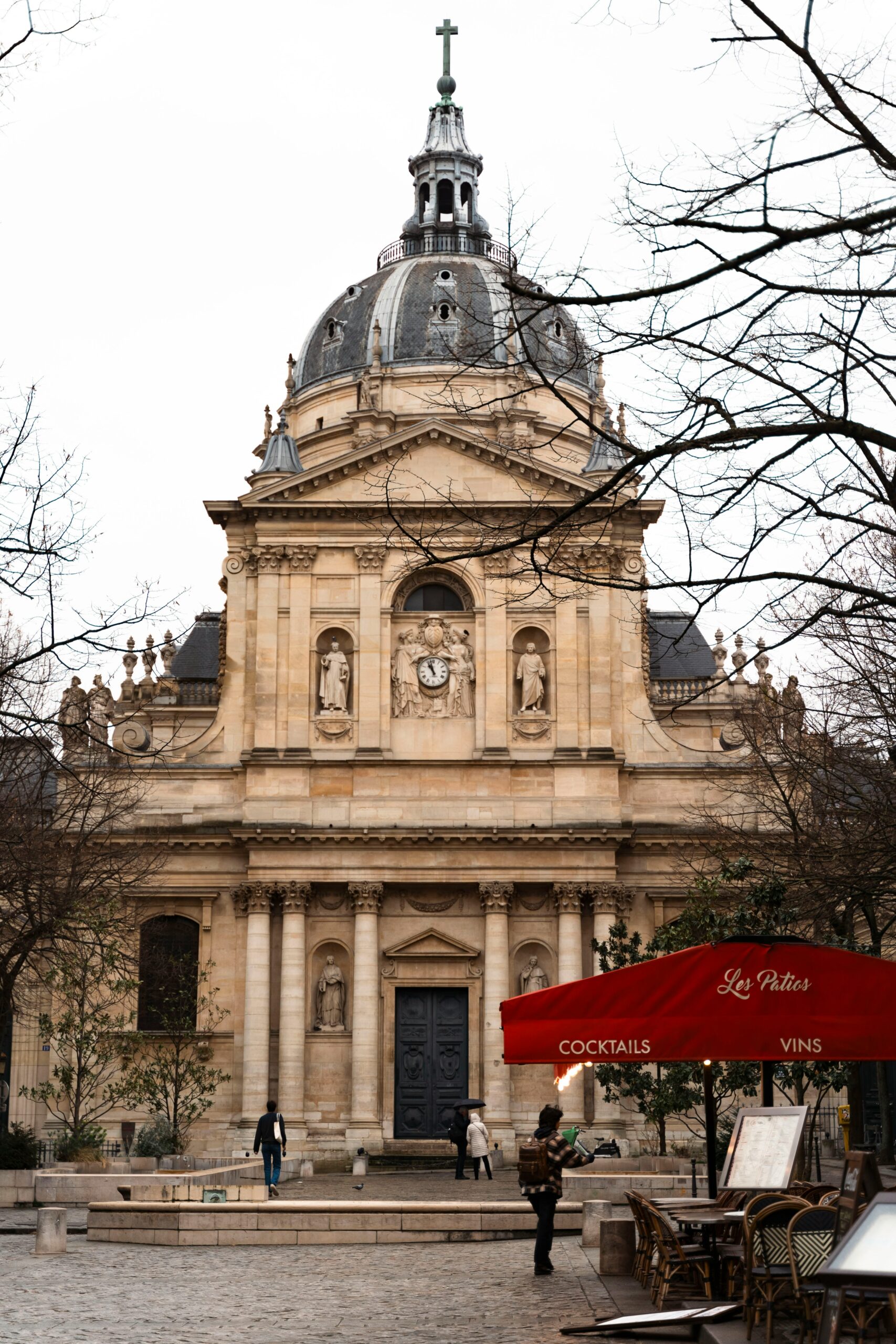
It was this same pious and intellectually curious king who, at the very same time, was patron to his chaplain, Robert de Sorbon. With the king’s support, Sorbon would establish a college in Paris in 1257 dedicated to theology students of modest means. That institution would become the legendary Sorbonne, the historical heart of our own CCFS. This shared connection highlights the vibrant intellectual and spiritual environment of Louis IX’s court, a world where a mission to the ends of the earth could be conceived in the same circle that would give birth to one of the world’s most famous universities.
Driven by a mix of diplomacy and missionary zeal, Louis IX dispatched William of Rubruck in 1253. Having recently suffered defeat in the Seventh Crusade, the king was intrigued by rumors about the Mongols. Could this powerful empire be an ally? Furthermore, the legend of Prester John—a mythical Christian king in the East—fueled hopes that the Mongols might have Christian sympathies. William’s mission was to find out.
The long and perilous road to Karakorum
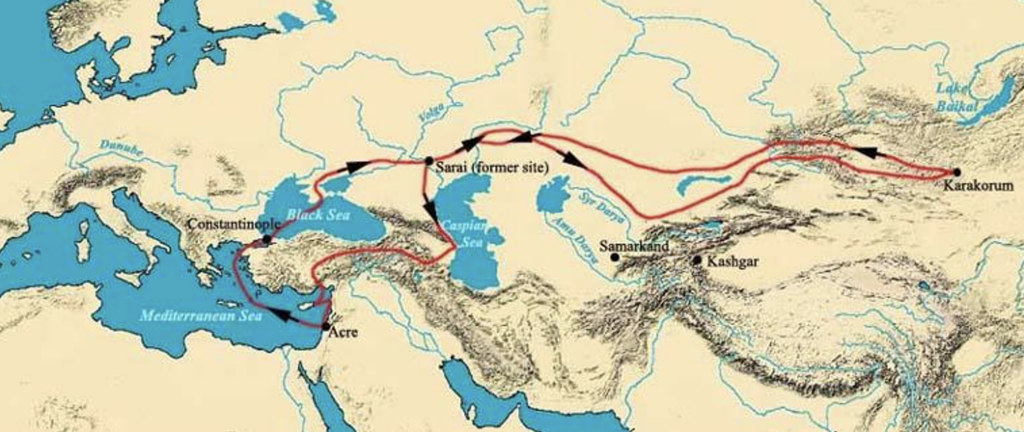
Armed with little more than his faith and a letter from the French king, William embarked on an epic overland journey. From Constantinople, he crossed the Black Sea and traversed the vast, unforgiving steppes of Central Asia. He endured extreme weather, hunger, and the constant uncertainty of traveling through lands under the control of the world’s most feared warriors.
Unlike a merchant caravan, William traveled simply, embodying the Franciscan vow of poverty. His humility and lack of material wealth often baffled his Mongol hosts, for whom power and possessions were intrinsically linked. After months of grueling travel, in late 1253, he finally reached the court of the Great Khan, Möngke Khan, grandson of Genghis Khan.
An anthropologist before his time: a frenchman in the mongol capital
William’s destination was Karakorum, the cosmopolitan capital of the Mongol Empire. His detailed account of the city is one of the most precious historical sources of the era. He was a meticulous and surprisingly objective observer, providing Europe with its first-ever reliable, first-hand description of Mongol life.
He described:
- Mongol society: Their nomadic lifestyle, their felt homes (gers), their diet (including the famous fermented mare’s milk, kumis), and their social customs.
- A Cosmopolitan capital: Far from being a simple camp, Karakorum was a walled city with distinct quarters for foreign craftsmen—including a Parisian goldsmith named Guillaume Boucher—and merchants from across Eurasia.
- Religious diversity: William was astonished by the religious tolerance he witnessed. He provides an invaluable account of the co-existence of shamanists, Nestorian Christians, Buddhists, and Muslims, all vying for influence at the Khan’s court. He even participated in a famous formal debate between the faiths, organized by Möngke Khan himself.
His descriptions were largely free of the fantasy and exaggeration common in other travelogues. He debunked myths about monstrous races in the East and presented the Mongols not as monsters, but as a complex people with a sophisticated, if brutal, imperial system.

The report that history almost forgot
Upon his return in 1255, William was unable to report to Louis IX in person. Instead, he wrote a long, detailed letter to the king known as the Itinerarium. This remarkable document is a masterpiece of medieval literature and ethnographic observation.
So why did it not achieve the fame of Marco Polo’s Travels?
- Purpose: William’s work was an official intelligence report for a king, not a commercial travelogue written for public entertainment. Its tone is formal and precise.
- Circulation: It circulated in manuscript form among a small circle of scholars, whereas Polo’s book, filled with more sensational stories, was widely distributed and became a medieval bestseller.
Despite its relative obscurity, historians consider William’s account to be more accurate and reliable than Polo’s. He was a careful observer who distinguished between what he saw himself and what he heard from others. His work is a foundational text in the history of anthropology and a testament to the intellectual curiosity of 13th-century France.
Explore the global reach of french civilization
The story of William of Rubruck challenges us to broaden our understanding of “French civilization.” It is a story intrinsically linked to the origins of the Sorbonne itself. Both the explorer’s mission and the university’s foundation were born from the intellectual and spiritual dynamism of King Louis IX’s court. This global perspective has been a part of the French identity for centuries.
For students from the United States, Sweden, Asia, and all over the globe, learning French at the Cours de Civilisation Française de la Sorbonne is an invitation to explore this rich and multifaceted history. Our programs are designed to immerse you in the cultural, literary, and historical currents that have shaped France and its role in the world.
Discover the pioneers, poets, and thinkers who define French culture. Go beyond the language and explore the civilization that created it.