How does a nation’s story begin? For France, the answer lies in a period of profound chaos and transformation: the Early Middle Ages. As the Western Roman Empire crumbled, new peoples and powers rose to take its place. It was a murky, violent, and formative era. Without a guide, this crucial chapter of history would be lost to us. Fortunately, France has such a guide: a Gallo-Roman bishop named Gregory of Tours.
Gregory was the primary chronicler of this pivotal age. His life’s work, the Historia Francorum (History of the Franks), is the single most important document for understanding the genesis of France. For anyone studying French, from beginners to academics, Gregory of Tours is not just a historical figure; he is the original storyteller of France’s national epic. At the Cours de Civilisation Française de la Sorbonne (CCFS), we delve into foundational figures like Gregory to offer our students not just language skills, but a true understanding of the historical DNA of French civilization.
Who was Gregory of Tours? A man between two worlds
Born Georgius Florentius around 538 AD in what is now Clermont-Ferrand, Gregory was a man who stood at a crossroads of history. He was a product of the old world—a member of a wealthy and influential Gallo-Roman aristocratic family that had served the Roman Empire for generations. Yet, he lived his entire life in a new world, a realm now ruled by the Franks, a Germanic people who had established a powerful kingdom in the former Roman province of Gaul.
In 573, he became the Bishop of Tours, a position of immense religious and political power. The city of Tours was a major pilgrimage site, home to the tomb of Saint Martin, and this role placed Gregory at the very center of the political intrigues and violent power struggles of the Merovingian kings, the descendants of Clovis I. He was not a detached scholar writing from a quiet monastery; he was a key player, an advisor, a diplomat, and a keen observer of the turbulent events unfolding around him.
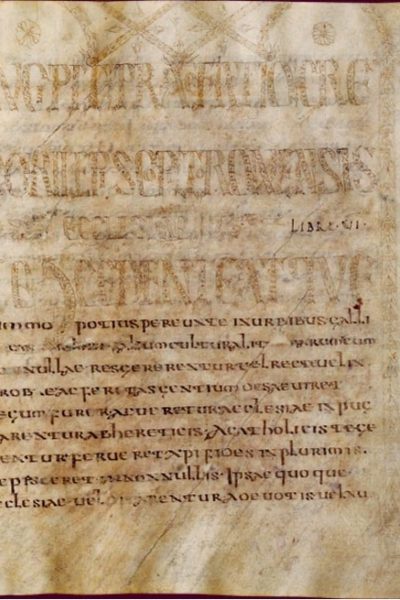
The Historia Francorum: more than just a history
Gregory’s masterpiece is a monumental work in ten books. It begins with the creation of the world but quickly focuses on the history of his own time. The Historia Francorum is our principal, and sometimes only, source for the events that forged the kingdom of the Franks. It is not a history book in the modern sense. Gregory weaves together grand political events, biographies of saints, descriptions of miracles, local gossip, and his own personal experiences. Yet, through his narrative, he provides an unparalleled, ground-level view of what life was like during the birth of medieval France.
Without Gregory, this entire period would be little more than a collection of archaeological finds and fragmented records. He gave it a voice, a narrative, and a cast of unforgettable characters.
Three foundational stories from the Historia Francorum
To understand Gregory’s importance, one need only look at the epic stories he preserved. While he was an eyewitness to the events of his own lifetime, his history also reached back to capture the world-shaping events that set the stage for the Frankish kingdom.
- The stand against Attila the Hun (451 AD)
Long before his time, a terrifying threat emerged from the East: Attila the Hun, the “Scourge of God.” In his History, Gregory recounts the story of the Battle of the Catalaunian Plains. In this monumental clash, a fragile coalition was formed to confront the Huns’ devastating invasion of Gaul. This army was led by the Roman general Aetius and brought together crucial allies, including the Visigoths under their king Theodoric I, and the Salian Franks under their leader Merovech. Gregory’s chronicle preserves the memory of this brutal battle, which ultimately halted Attila’s westward advance. By recording this event, Gregory didn’t just tell a war story; he cemented the legacy of a pivotal moment when Romans, Goths, and Franks united to defend the future of Gaul, the very land the Franks would soon inherit. - The baptism of Clovis (c. 496)
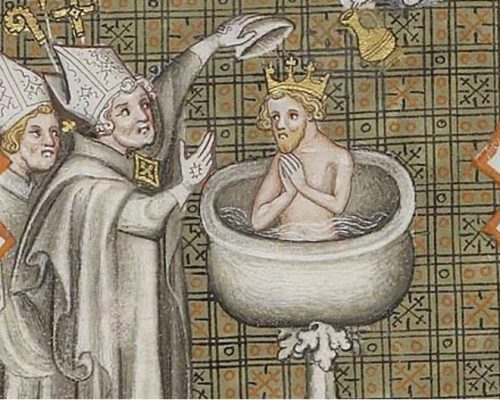
Gregory provides the most famous account of Clovis’s conversion to Catholicism. Urged by his wife, Clotilde, Clovis pledges to convert if the Christian God grants him victory. He wins the battle and is baptized by Bishop Remigius of Reims. This event is arguably the most significant in early French history. By adopting the Catholicism of his Gallo-Roman subjects, Clovis forged a powerful alliance between the Frankish monarchy and the Church that would define the French state for centuries and earn France the title “Eldest Daughter of the Church.” - The vase of Soissons
This famous anecdote illustrates the clash of cultures. After a battle, a bishop begged King Clovis to return a precious vase. Clovis agreed, but Frankish custom required spoils to be divided by lot. When Clovis requested the vase, a soldier defiantly smashed it. A year later, Clovis recognized the soldier, accused him of having poorly maintained weapons, and split his skull with his axe, declaring, “Thus you did to the vase at Soissons!” This raw story, vividly told by Gregory, demonstrates the personal and violent nature of Frankish kingship.
The Enduring Legacy of a Founding Father
Gregory of Tours died in 594, but his work endured. He became, in effect, the “Herodotus of the Franks.” While he wrote to provide moral lessons for the future, he inadvertently created a national origin story. He captured the moment when Roman Gaul died and medieval France was born—a unique fusion of Roman institutions, Germanic warrior culture, and the Catholic faith.
To study Gregory is to understand the very foundations upon which centuries of French history, culture, and identity would be built.
Discover the foundations of french civilization at CCFS
For international students from the United States, Sweden, Asia, and beyond, learning French is a gateway to a rich and complex culture. At the Cours de Civilisation Française de la Sorbonne, we believe that a deep appreciation of the language comes from understanding its historical context.
Our civilization courses are designed to take you on a journey through time, exploring the key figures, pivotal events, and foundational texts—like Gregory’s History of the Franks—that have shaped France. Move beyond simple grammar and vocabulary and immerse yourself in the epic story of French civilization.
Ready to explore the origins of France? Visit our course page to find the program that will begin your journey.