A Winter Night on the Montagne Sainte-Geneviève
Paris, winter 1257. On the left bank of the Seine, in a narrow alley climbing the montagne Sainte-Geneviève, a candle burns behind a shuttered window. A young man from Champagne, fingers stiff with cold, copies a passage from Peter Lombard’s Sentences onto a worn sheet of parchment. He shares his room with three other theology students. They sleep two to a bed. In the morning, they will walk down to the rue du Fouarre, sit on bales of straw, and listen to a master expound on Aristotle.
This young man is poor. Not destitute — he has access to books, which makes him privileged by medieval standards. But he holds no ecclesiastical benefice. No noble family funds his studies. Theology demands ten to fifteen years of sustained work. Without help, he will have to abandon his education.
It is for students like him that Robert de Sorbon, chaplain to King Louis IX, is founding a college. A place where impoverished students can study theology while receiving room, board, and heat. The college will bear its founder’s name. Seven centuries later, that name still designates one of the most celebrated institutions in the world.
But the story of the Sorbonne does not begin in 1257. Its roots reach back two centuries earlier, to the cathedral schools clustered around Notre-Dame.
From Cathedral Schools to Studium Generale
In the early twelfth century, Paris is not yet a university city. It is a growing town, protected by the early Capetian kings, bisected by a river that makes it a commercial crossroads. On the Île de la Cité, the cathedral school of Notre-Dame trains clerics under the authority of the chancellor of the chapter. The curriculum covers grammar, rhetoric, and dialectic — the trivium inherited from late Antiquity.
What transforms Paris is the arrival of one man: Peter Abelard. A brilliant philosopher and formidable polemicist, Abelard draws hundreds of students by the sheer force of his teaching. Jacques de Vitry, in his Historia Occidentalis, describes the flood of students toward Paris as unprecedented. Abelard teaches first on the montagne Sainte-Geneviève, outside the chancellor’s jurisdiction. He sets a decisive precedent: one can teach outside the cathedral framework.
Other masters follow. Hugh of Saint-Victor teaches at the abbey of the same name. The canons of Sainte-Geneviève welcome lecturers. The left bank fills with independent schools. Students speak Latin to one another — hence the name Quartier Latin, which still designates this student territory in the heart of Paris.
The institutional turning point comes between 1200 and 1215. In 1200, Philip Augustus grants the masters and students of Paris a royal privilege that removes them from ordinary justice. They now fall under ecclesiastical jurisdiction. This is a founding act: for the first time, the community of teachers and students — the universitas magistrorum et scholarium — is recognized as a distinct legal body.
In 1215, the papal legate Robert de Courçon promulgates the first statutes of the University of Paris. These statutes, preserved in the Chartularium Universitatis Parisiensis, fix the duration of studies, the curriculum, and the conditions for obtaining the licentia docendi — the licence to teach. Theology requires eight years of study beyond the master of arts degree. The faculty of arts, which teaches the seven liberal arts, serves as a compulsory foundation.
In 1231, Pope Gregory IX’s bull Parens Scientiarum consecrates the University’s autonomy. The text is explicit: Paris is the “mother of the sciences,” and the University has the right to set its own regulations. This is the birth certificate of the studium generale — an institution of higher learning recognized by universal authority, whose degrees are valid throughout Christendom.
Robert de Sorbon: A Chaplain Who Changed History
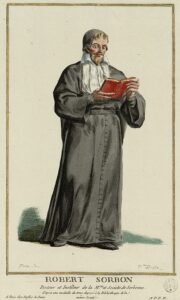
Robert was born in 1201 in Sorbon, a village in the Ardennes. The son of peasants, he studied in Paris under the protection of ecclesiastical benefactors. He became a master of theology, then a canon of Paris. Louis IX, who had reigned since 1226, made him his chaplain and confessor.
Robert knew from personal experience the precariousness facing poor students. The faculty of theology, the most prestigious in Paris, was also the longest and most expensive. Wealthy students — sons of nobles or holders of prebends — could endure. The rest dropped out. Robert intended to correct this injustice.
In 1257, he obtained from Louis IX the cession of several houses on the rue Coupe-Gueule, on the montagne Sainte-Geneviève. There he founded the “house of Sorbonne” — a college designed to house secular theology students, meaning clerics who belonged to no religious order. The Dominicans and Franciscans had their own convent-schools. Secular students had nothing. Robert filled this gap.
The founding charter established precise rules. The college housed sixteen bursars, four per nation. Each bursar received lodging, meals, and access to a library. In return, he was required to participate in academic exercises and lead a regular life. A provisor elected by the bursars administered the house. It was a communal model, egalitarian in its principle.
Robert de Sorbon also composed texts on the method of study. His De Conscientia insists on self-examination and intellectual rigor. He compares preparing for a theology examination to preparing for the Last Judgment — with a dry wit that surprises in a thirteenth-century theologian.
The college of Sorbon flourished. Its library became one of the richest in Paris. Its theological disputations attracted outside listeners. Within decades, the name “Sorbonne” came to designate not only the college but the entire faculty of theology, then the university itself. A revealing semantic shift: the part had absorbed the whole.
This link between Robert de Sorbon and the institution he founded endures today. The Fondation Robert de Sorbon, the legal entity that carries his name, perpetuates his mission. It is this foundation that administers the Cours de Civilisation Française de la Sorbonne, extending a vocation of teaching born nearly eight centuries ago.
The Parisian Model: Four Faculties, Four Nations
The University of Paris was not a campus in the modern sense. It was a corporation — a body of persons bound by common statutes. It owned no building of its own before the fourteenth century. Lectures were held in rented halls, in churches, sometimes in the open air.
The University was divided into four faculties: arts, theology, canon law, and medicine. The faculty of arts was by far the largest. It admitted students from the age of fourteen for a course of approximately six years. They studied the logic of Aristotle, the grammar of Priscian, the astronomy of Ptolemy. Masters of arts were often very young — twenty years old, sometimes less.
Theology stood at the summit of the edifice. It was the “queen of the sciences” in medieval parlance. One had to be a master of arts to enter. The course lasted a minimum of eight additional years. Students commented on the Sentences of Peter Lombard and disputed questions on the Trinity, grace, and free will. Thomas Aquinas, Bonaventure, Duns Scotus — the greatest minds of the thirteenth century passed through this faculty.
The faculty of canon law — civil law was banned in Paris by Pope Honorius III in 1219 — trained the jurists of the Church. The faculty of medicine, smaller still, taught Hippocrates and Galen. Both remained modest compared to their counterparts in Bologna or Montpellier.
What distinguished Paris was the system of nations. The faculty of arts was divided into four “nations” grouping students by geographical origin: the nation of France (which included Spaniards, Italians, and Easterners), the nation of Picardy, the nation of Normandy, and the nation of England (which also encompassed Germans and Scandinavians). Each nation elected a proctor. The four proctors elected the rector of the University.
This elective system was remarkable. The rector was appointed neither by the king nor by the pope. He was elected by his peers. His term was short — three months initially, later one year. The University of Paris was, in effect, one of the first European institutions to practice a form of representative democracy.
The system of degrees formalized the academic path. The baccalarius (bachelor) had completed the first part of his studies. The licentiatus (licentiate) had received the licentia docendi from the chancellor. The magister (master) or doctor had been received by his peers in a ceremony of inceptio. These terms — bachelor, licentiate, doctor — remain ours today. The vocabulary of global higher education was born in Paris.
Daily Life in the Quartier Latin
Jean de Jandun, in his Éloge de Paris composed around 1323, describes the left bank as an incomparable seat of learning. He celebrates the “flowers of every science” that bloom in the Parisian schools. The daily reality was rougher.
Students lived in difficult conditions. The luckiest held a place in a college — the Sorbonne, the Collège de Navarre founded in 1305, the Collège d’Harcourt. The rest rented rooms in lodgings run by local bourgeois. Rents were a constant source of friction between the University and landlords. The Chartularium preserves numerous complaints on this subject.
The day began early. Ordinary lectures (lectiones ordinariae) were held in the morning, from prime to tierce — roughly six o’clock to nine. Extraordinary lectures filled the afternoon. The master read a text — legere, to read, whence the word “lecture” — and commented upon it. Students took notes on wax tablets or parchment notebooks.
The central intellectual exercise was the disputatio. At least twice a week, masters and bachelors engaged in codified argumentative contests. A respondens defended a thesis. An opponens challenged it. The master resolved the debate with a determinatio. Twice a year, quodlibetal disputations allowed anyone in the audience to pose any question to the master. Thomas Aquinas excelled at this exercise. His Quaestiones Disputatae and Quodlibetales are monuments of scholastic thought.
The language of this entire universe was Latin. Among themselves, in the street, at the market, students spoke Latin. It was a lingua franca that allowed an Englishman, a German, and a Sicilian to understand one another. This tradition of a shared language may be the deepest legacy of the medieval university. Today, the Cours de Civilisation Française de la Sorbonne carry on this vocation of linguistic welcome: French has replaced Latin, but the idea remains the same — to offer a common language to students from around the world.
Life was not exclusively studious. The registers of the Parlement de Paris record brawls between students and townspeople, fights between rival nations, and taverns wrecked in the aftermath. In 1229, a fight between students and tavern-keepers spiraled out of control. The royal police intervened and killed several students. The University went on strike and left Paris for two years. It was this crisis that led to the bull Parens Scientiarum of 1231. The University learned that it was powerful enough to force a king’s hand.
Students were not a homogeneous group. Some were sons of nobles like those who populated the court of Eleanor of Aquitaine, endowed with comfortable incomes. Others survived by copying manuscripts, serving as secretaries, or begging. Goliardic poetry — the songs of wandering students celebrating wine, love, and freedom — testifies to this medieval bohemia. The Quartier Latin was a world unto itself, with its own codes, its own language, and its own culture.

European Influence: Paris as Matrix
The Parisian model did not remain Parisian. It spread with remarkable speed. Between the thirteenth and fifteenth centuries, dozens of universities were founded across Europe, and nearly all borrowed something from Paris.
Oxford is the most direct case. From the twelfth century onward, masters trained in Paris taught in England. The strike of 1229 sent entire contingents of masters and students across the Channel. Oxford adopted the system of nations, Parisian degrees, and the faculty structure. Cambridge was born in 1209 from a secession from Oxford — itself a daughter of Paris. The English college system drew direct inspiration from Parisian colleges such as the Sorbonne.
Bologna, in Italy, followed a different path. Its university was founded by students, not masters. It was a universitas scholarium, where Paris was a universitas magistrorum. But Bologna borrowed from Paris the system of degrees, the structure of examinations, and the principle of corporate autonomy.
On the Iberian Peninsula, Salamanca (1218) and Coimbra (1290) adopted the Parisian model for theology and the arts while following Bologna for law. The statutes of Salamanca explicitly mention Paris as a reference.
To the east, the University of Prague, founded in 1348 by Charles IV, was organized on the Parisian model with its four nations. Kraków (1364), Vienna (1365), and Heidelberg (1386) followed. Each foundation reproduced the same elements: four faculties, a system of degrees, corporate autonomy, and juridical privileges.
What circulated was not merely an institutional structure. It was an ideal: the idea that universal knowledge exists, is accessible through reason, is transmissible through teaching, and that the institutions devoted to it deserve special protection. This idea was born in Paris in the thirteenth century. It still structures higher education worldwide.
Intellectual exchanges accompanied institutional ones. The same texts circulated from Paris to Oxford, from Bologna to Prague. Aristotle, as commented by Averroes, was taught everywhere. Peter Lombard’s Sentences served as the theology textbook for all of Europe. This common intellectual culture — what historians call the res publica litteraria — was the direct product of the university network centered on Paris.
Vernacular literature itself bore the mark of this intellectual ferment. When Chrétien de Troyes invented the European novel in the late twelfth century, he was writing in a world where Paris-trained clerics disseminated learned culture in the vernacular. The passage from Latin to French, from university to court, from disputatio to narrative, was one of the great cultural movements of the Middle Ages.
And while the masters disputed on the montagne Sainte-Geneviève, the builders of cathedrals were transforming Paris into a permanent building site. Notre-Dame rose between 1163 and 1345. The Sainte-Chapelle was consecrated in 1248, nine years before the founding of the Sorbonne. The city that invented the university also invented Gothic architecture. These two creations shared the same impulse: the conviction that human reason can reach the divine.
A Living Legacy: From 1257 to Today
The college of Sorbon survived its founder, who died in 1274. It endured through the centuries with varying fortunes. In the seventeenth century, Cardinal Richelieu, as provisor of the Sorbonne, had the buildings reconstructed. The chapel visible today dates from this period. The Revolution suppressed the University and closed the colleges. Napoleon refounded the Imperial University in 1808. The Sorbonne was reborn, but in a very different form.
What did not change was the vocation. Since Robert de Sorbon, this institution has welcomed students from elsewhere who come to learn. The bursars of the thirteenth century came from England, Picardy, Normandy, and the Germanic lands. They came seeking knowledge they could not find at home. They left with a degree recognized across Europe.
Today, the Cours de Civilisation Française de la Sorbonne carry on this tradition in a form adapted to the contemporary world. Created in 1919 to teach French language and civilization to international students, the CCFS are administered by the Fondation Robert de Sorbon — the direct heir of the medieval founder. The link is not symbolic. It is juridical, historical, and intellectual.
The Fondation Robert de Sorbon bears the name of the man who, in 1257, decided that knowledge should not be reserved for the wealthy. That students from everywhere deserved a place to learn. That teaching was a mission, not a transaction. The CCFS carry this same heritage. Their civilization lectures extend the tradition of the medieval lectiones. Their French courses extend the tradition of the shared language. Their home within the Sorbonne extends the continuity of a place.
The Quartier Latin has changed. The straw bales of the rue du Fouarre have given way to lecture halls. Latin has yielded to French. Students no longer sleep two to a bed in unheated colleges. But the essential remains. Young people from around the world still climb the slope of the montagne Sainte-Geneviève to learn. They still pass the chapel of the Sorbonne. They still enroll in an institution that bears the name of Robert de Sorbon.
Seven centuries separate the theology bursar of 1257 from the French-language student of 2026. What connects them is a simple and powerful idea: knowledge is taught, knowledge is shared, and Paris is a good place to do both.
The Fondation Robert de Sorbon continues to carry this idea. Those who wish to join this lineage can do so by enrolling in CCFS programs. The story did not end in 1257. It continues, lecture by lecture, student by student, within the very walls where it began.
Primary sources: Chartularium Universitatis Parisiensis (ed. Denifle & Chatelain, 1889–1897); Jacques de Vitry, Historia Occidentalis (c. 1225); Jean de Jandun, Tractatus de laudibus Parisius (c. 1323); Bull Parens Scientiarum by Gregory IX (1231); Statutes of Robert de Courçon (1215); Founding charters of the college of Sorbon (1257–1263).