
Who was François Villon, the cursed poet of the Middle Ages?

He killed a priest, burgled a college, came within a rope’s length of the gallows, then vanished without trace at thirty-one. François Villon is also the greatest French poet of the Middle Ages, the one who brought into the language the ache of passing time and the voice of a man alone before his own death. We know this life of wandering and crime mostly through court records and through his own verse, where he stages his faults without ever apologising. Here is who Villon was: the University of Paris student who became the original cursed poet.

Key facts

  • François Villon, born around 1431 in Paris, real name François de Montcorbier, is the most widely read medieval French author today.
  • Orphaned young, he was raised by the canon Guillaume de Villon, whose name he took, and became a Master of Arts of the University of Paris in 1452.
  • His life turned in 1455 when he killed a priest in a brawl, then took part in the 1456 burglary of the Collège de Navarre.
  • Sentenced to hang in 1462, he had the sentence commuted on 5 January 1463 to ten years of banishment from Paris. After that date, his trail goes cold for good.
  • His work amounts to only a few thousand lines, among them The Testament and the Ballad of the Hanged Men, which have survived six centuries.

A student of the University of Paris

François Villon was born around 1431 in Paris, under the name François de Montcorbier. His father died while he was still a child. He was taken in by Guillaume de Villon, a canon and chaplain of the Saint-Benoît-le-Bétourné chapel, a short walk from the Sorbonne. This guardian gave him his name, his home and his schooling. The poet would later describe him as one who was kinder to him than a mother to her child.

Young Villon followed the curriculum of the University of Paris, one of the most prestigious in Europe. He earned his bachelor’s degree in 1449 and the title of Master of Arts in 1452. He was then about twenty-one, with every door open to him: the Church, teaching, administration. He lived in the heart of a bustling student district, the turbulent Latin Quarter that the medieval University of Paris, with the Sorbonne at its centre, had brought to life.
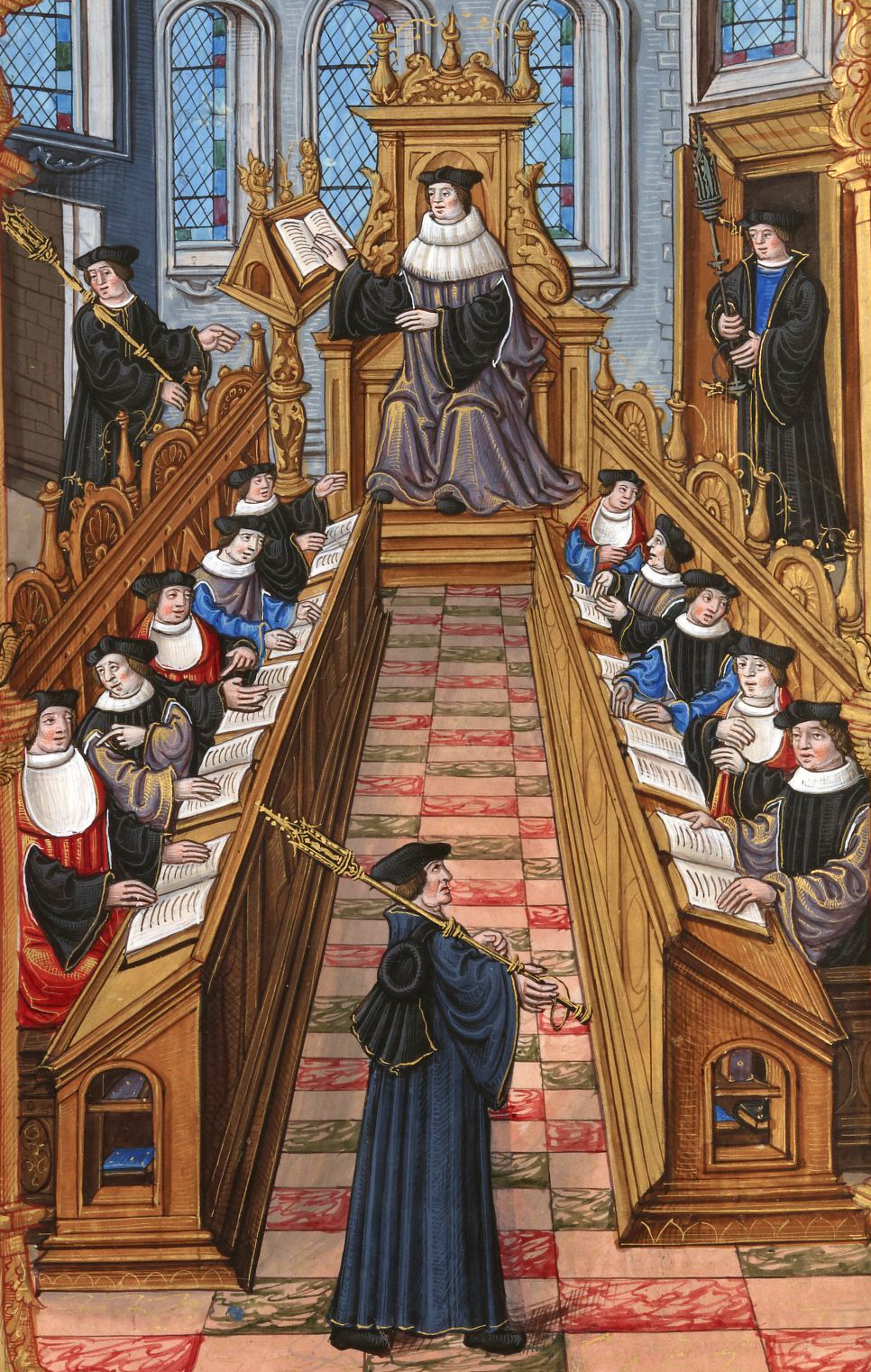
Gathering of scholars at the medieval University of Paris
The medieval University of Paris, where Villon earned his Master of Arts. Public domain, via Wikimedia Commons.

From murder to burglary: a life on the run

On 5 June 1455, a quarrel broke out in the cloister of Saint-Benoît. Villon fatally wounded a priest, Philippe Sermoise, with a dagger. He fled the city. He won a royal pardon in January 1456 and returned to Paris, but the respite was brief.

At Christmas 1456, he took part in the burglary of the Collège de Navarre, from which a large sum was stolen. He left the capital again, this time for long years of wandering. It was in this period that he composed the Lais, also called the Lesser Testament: a farewell poem, half serious and half mocking, in which he bequeaths, in jest, goods he does not own. On the road, he was for a time received at the court of Charles d’Orléans, prince and poet, at Blois.

In 1461 he was imprisoned in harsh conditions at Meung-sur-Loire, on the orders of Bishop Thibault d’Aussigny. He was freed when the new king, Louis XI, passed through. Out of this ordeal came his masterpiece.

A body of work born at the margins

After his release, around 1461, Villon wrote The Testament, a long poem of roughly two thousand lines into which his most famous ballads are set. The tone is dizzying: it opens on a bitter reckoning with his own life, when, in his thirtieth year, he had drunk down all his shame.

Villon speaks of himself plainly: poverty, prison, lost loves, the fear of growing old and dying. It is this personal, almost modern voice that sets him apart from the courtly poetry of his time. In the Ballad of the Ladies of Times Past, he captures the whole flight of time in a single line, “But where are the snows of yesteryear?”, probably the best-known line in French poetry.

Late in 1462, back in Paris, he was caught up in another brawl and sentenced to be hanged. While awaiting the rope, he wrote the Ballad of the Hanged Men, in which he imagines his own corpse swinging from the gibbet and begs the living for mercy: “Brother men who live after us, do not harden your hearts against us.”

The disappearance of 1463, then silence

On 5 January 1463, the Parlement of Paris overturned the death sentence and commuted it to ten years of banishment from the city. Villon was a little over thirty. He left Paris. After that date, no document mentions him again. Where and when he died is unknown.

This final silence fed the legend of the cursed poet, gone like one of those fugitive, marginal figures he had written about. He left behind no tomb and no certain portrait, only a brief, burning body of work that printers were already publishing in 1489, a sign of immediate success.

Why read Villon today

Six centuries on, Villon is still read because he speaks of what does not age: poverty, remorse, desire, death. His language, Middle French, asks for a little effort, but modern editions make it accessible, and the reward is immediate. The poets who reread him, from Rimbaud to the songwriters of French chanson, owe him something.

Reading Villon in the original is also a way to measure how far the French language has travelled. That is the point of learning French at its source: at the Cours de Civilisation Française de la Sorbonne, the language is studied together with its literature and history. Discover our French courses in Paris, from beginner to advanced level.

Frequently asked questions

Who was François Villon?

A fifteenth-century French poet, born around 1431 in Paris and gone after 1463. A Master of Arts of the University of Paris, he led a bohemian life marked by a killing, a burglary and a death sentence, while writing one of the major bodies of work of the Middle Ages.

Why is Villon called the “cursed poet”?

Because his life combined the margins, prison and flight, and because he finally vanished without trace in 1463. The phrase, popularised later, describes poets with tragic destinies, of whom Villon is the first French model.

What are Villon’s best-known works?

The Testament, his masterpiece, along with the ballads set within it: the Ballad of the Ladies of Times Past (“where are the snows of yesteryear?”) and the Ballad of the Hanged Men. He also wrote the Lais, or Lesser Testament.

How did François Villon die?

Nobody knows. After his sentence of banishment on 5 January 1463, no further document mentions him. His disappearance remains one of the great mysteries of French literary history.

Did Villon study at the Sorbonne?

He studied at the University of Paris, of which the Sorbonne was the most famous college, and lived in the nearby Latin Quarter. He earned the title of Master of Arts there in 1452.


Article written by the team at the Cours de Civilisation Française de la Sorbonne and editorially reviewed before publication. Last updated: June 2026. Biographical details drawn from standard reference sources on Villon (Encyclopædia Universalis, Britannica). Dates before 1463 are established from court records and from the poet’s own works.
Similar articles

French Language Proficiency Levels: A Complete Guide to CEFR A1-C2

Mastering French Language Proficiency Levels: A Comprehensive Guide to CEFR Standards and Realistic Timelines Have you ever wondered how many French language proficiency levels exist and how long it takes to master each one? Understanding the CEFR framework is key to measuring your progress, from basic communication to advanced fluency. With six distinct levels—ranging from A1 (beginner) to C2 (mastery)—this

Read more
Logo des Cours de Civilisation Française de la Sorbonne
visage popup ccfs - Cours de Civilisation Française de la Sorbonne

CCFS Discovery Week
From July 16 to 26

Experience CCFS before your courses even begin!

CCFS Sorbonne invites you to take part in an exceptional Discovery Week — the perfect opportunity for future students, curious minds, and lovers of the French language and culture to immerse themselves in the unique world of CCFS.

On the agenda: campus tour, online trial classes, online lectures…
All events are free but require registration. Limited slots.

Semaine de découverte des CCFS du 16 au 26 juillet

Venez vivre l’expérience CCFS avant même de commencer vos cours !

Les Cours de Civilisation Française de la Sorbonne vous ouvrent leurs portes lors d’une semaine de découverte exceptionnelle : l’occasion idéale pour les futurs étudiants, les curieux et les passionnés de langue et de culture françaises de plonger dans l’univers unique des CCFS.

Au programme : visite du campus, cours d’essai en ligne, conférences en ligne… Inscription gratuite mais obligatoire. Places limitées.

Logo des Cours de Civilisation Française de la Sorbonne

Information

Attention, le secrétariat sera fermé le lundi 25 mai. Merci de faire vos démarches en ligne.

En raison des examens DELF/DALF, pourrais-tu mettre en ligne que le secrétariat sera exceptionnellement fermé aux dates suivantes :

  • Le 20 mai
  • Le 10 juin
  • Le 8 juillet

Les cours semestriels S10, S20, S40 et AN40 pour la rentrée de printemps sont désormais complets.
Pour vous inscrire en liste d’attente merci de contacter le secrétariat au 01 44 10 77 00

Semester courses S10, S20, S40, and AN40 for the spring semester are now full.
To join the waiting list, please contact the secretariat at
+331 44 10 77 00.

Focus

Découvrez les cours mensuels de français.

Ces programmes courts sont destinés à un public de niveau débutant, élémentaire ou intermédiaire (niveaux A0 à B1).

Étudiant des Cours de Civilisation Française de la Sorbonne

Discover monthly French courses.

These short programs are designed for beginners, elementary, or intermediate learners (levels from A0 to B1).

They combine French language classes and speaking practice sessions to help students quickly improve their mastery of the French language.

 📣  Conférence découverte “Explorez Lyon avec Mme Dally”

📅  Lundi 30 juin à 15h30
sur le campus des CCFS

 📣  Open Lecture – Explore Lyon with Ms. Dally

📅  Monday, June 30 at 3:30 PM
on CCFS campus

Participez gratuitement à une immersion culturelle vivante, accessible dès le niveau A2, à la découverte d’une ville emblématique du patrimoine français.

👉 Cette conférence est l’occasion idéale de découvrir le format de nos conférences et de visiter notre campus dans une ambiance conviviale !

📍 Lieu : Campus des CCFS
7-11 avenue des Chasseurs
75017 Paris
👥 Ouvert au public, sur inscription
🎓 Accessible à partir du niveau A2

Au programme :

– Accueil sur le campus (15h15)
– Conférence : Lyon, une ville à explorer (1h15 min)
– Échange avec l’enseignante & découverte des CCFS (15 min)

ℹ️ L’entrée est gratuite, dans la limite des places disponibles.
Merci de vous présenter à l’accueil à partir de 15h15.

Étudiant des Cours de Civilisation Française de la Sorbonne

OFFRE D’ÉTÉ

Bénéficiez de 20% de réduction sur tous les cours annuels et semestriels pour la rentrée de septembre 2024, pour toute inscription réalisée avant le 1er septembre, dans la limite des places disponibles.

Votre code promo :
SEPTEMBRE24

Étudiant des Cours de Civilisation Française de la Sorbonne

SUMMER DEALS

Get a 20% discount on all annual and semester courses for the September 2024 intake, for any registration completed before September 1st, subject to availability.

Your promo code:
SEPTEMBRE24

INFORMATION

Le secrétariat sera exceptionnellement fermé le jeudi 6 juin.

The secretariat will be exceptionally closed on Thursday, June 6. 

Dernières places disponibles pour la rentrée d'automne !

Profitez d’une remise exceptionnelle de 20% sur le cours intensif de français S40, les cours S10 et S20 et les cours du soir.

Les inscriptions fermeront le vendredi 13 septembre à minuit.

Pour s’inscrire :

  • Pour le cours S40, inscription sur ce site avec le code promo SEPTEMBRE24
  • Pour les cours du soir S5, inscription sur ce site avec le code promo SEPTEMBRE24
  • Pour les cours S10 et S20, inscription directement au secrétariat de l’institution, ouvert du lundi au vendredi de 9h30 à 12h30 et de 13h30 à 16h30.


Inscription dans la limite des places disponibles.

L’inscription à la session d’automne (rentrée du 16 septembre 2024) est encore possible, sous réserve de places disponibles.

Les étudiants souhaitant s’inscrire sont invités à se rendre directement au bureau des admissions de l’institution, ouvert du lundi au vendredi de 9h30 à 16h30.
Ils doivent s’assurer de disposer d’un visa valide.

L’inscription en ligne pour cette session n’est plus possible sur ce site.

Last spots available for the fall intake

Get an exclusive 20% discount on the intensive French course S40, S10 & S20 courses, and evening classes.

Registration will close on Friday, September 13th, at midnight.

To register:

  • For the S40 course, register on this website using the promo code SEPTEMBRE24.
  • For the evening classes S5, register on this website using the promo code SEPTEMBRE24.
  • For S10 & S20 courses, register directly at the institution’s office, open Monday to Friday from 9:30 am to 12:30 pm and from 1:30 pm to 4:30 pm.

Registration is subject to availability.

Registration for the fall session (starting on September 16, 2024) is still possible, subject to availability.

Students wishing to register are invited to go directly to the institution’s admission office, open Monday to Friday from 9.30am to 4.30pm.
They must ensure they have a valid visa.

Online registration for this session is no longer available on this website.

Dates des prochains examens TCF

Les prochaines sessions d’examen TCF auront lieu dans les locaux de l’institution aux dates suivantes :

Le 30 janvier et le 27 février :

TCF TP SOS’INSCRIRE
TCF TP SO
+ épreuve orale
S’INSCRIRE
TCF TP SO
+ épreuve écrite
S’INSCRIRE
TCF TP SO completS’INSCRIRE

Le 31 janvier et le 28 février :

TCF IRNS’INSCRIRE